UX CASE STUDY · 2024
ADORN
HOME.
Every tool helps you imagine a new room.
None of them help you work with the one you have.
Role
End-to-End
UX Designer
Industry
E-Commerce
Home Decor
Timeline
5-Day Design Sprint
PROBLEM
The Cart Was Full.
The Doubt Was Fuller.
The Purchase Never Happened.
01
Decision Paralysis
They love the pice but can’t commit without seeing it in their space.
02
Budget Anxiety
Every wrong purchase feels like a financial risk they can’t afford.
03
The Mismatch Fear
New Furniture has to live alongside everything they already own
“It looks great in the photo - but will it look right in MY living room?”
THE QUESTION THAT KILLS THE PURCHASE
The result? Abandoned Carts where confident purchases should have taken place.
SOLUTION
An AI Feature Built to Turn
Doubt Into Decisions.
01 —
Reducing Purchase Indecision
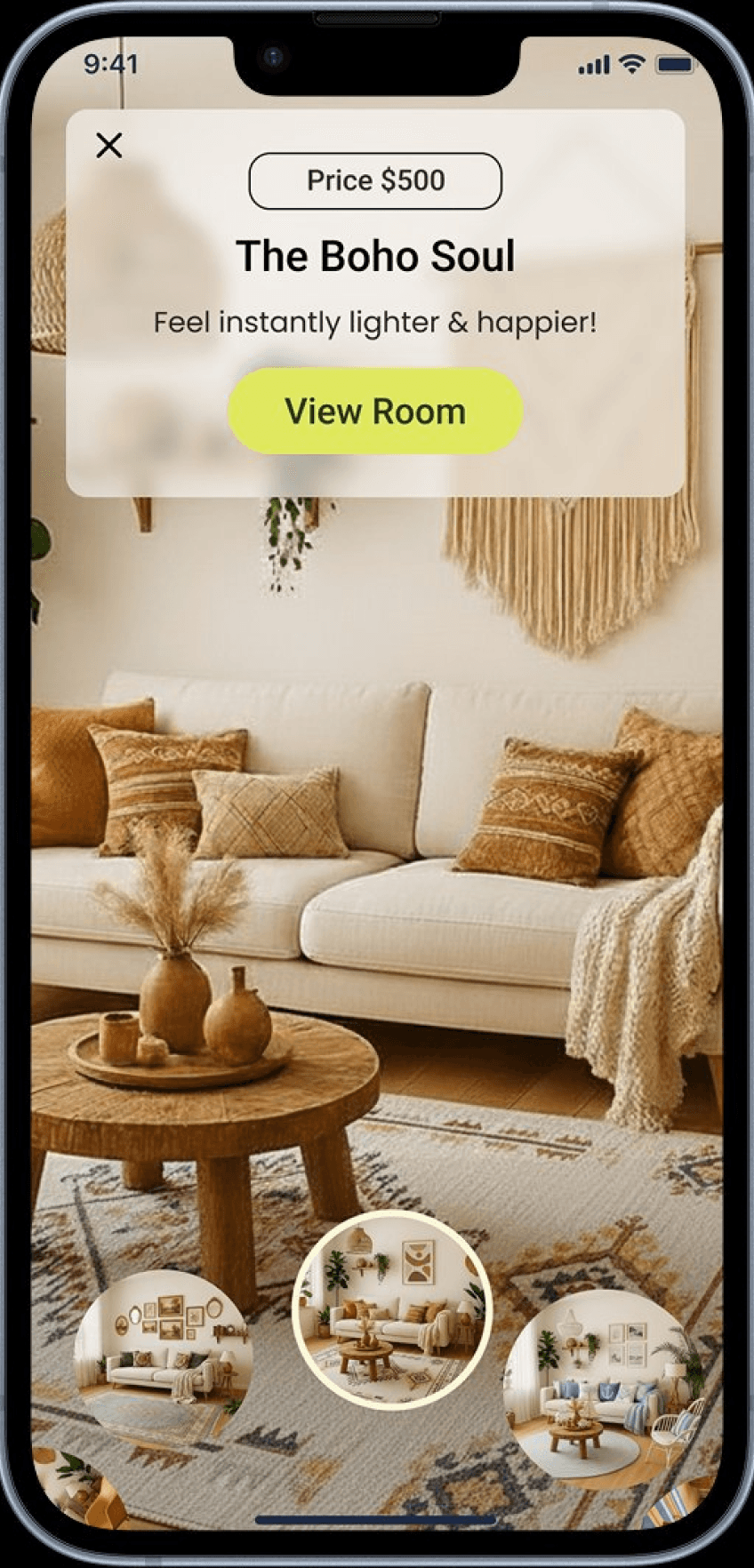
Scan your room and instantly see new products in your actual space alongside what you already own
Every concept is built within customer’s budget no surprises at checkout
Transforms abstract inspiration into something tangible and real
↓ purchase indecision & ↓ drop off rate
02 —
AI That Adapts to You
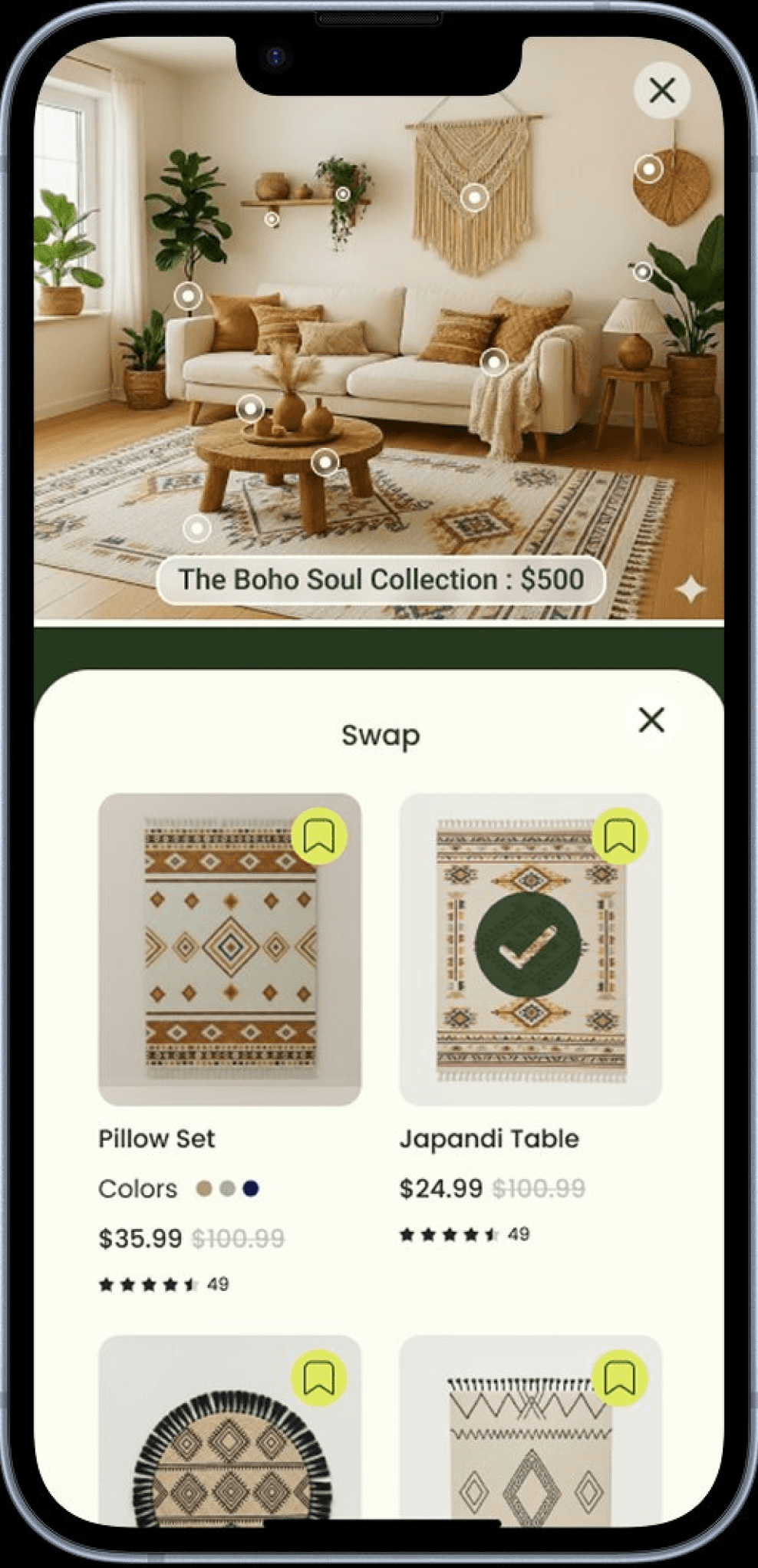
Swap any item for an AI matched alternative at the same price & aesthetic
Customer can explore more of their style of discover a different look all within budget
Real-time price updates as customer edits so the total never catches them off
↑ personalization & ↑ Repeat engagement
03 —
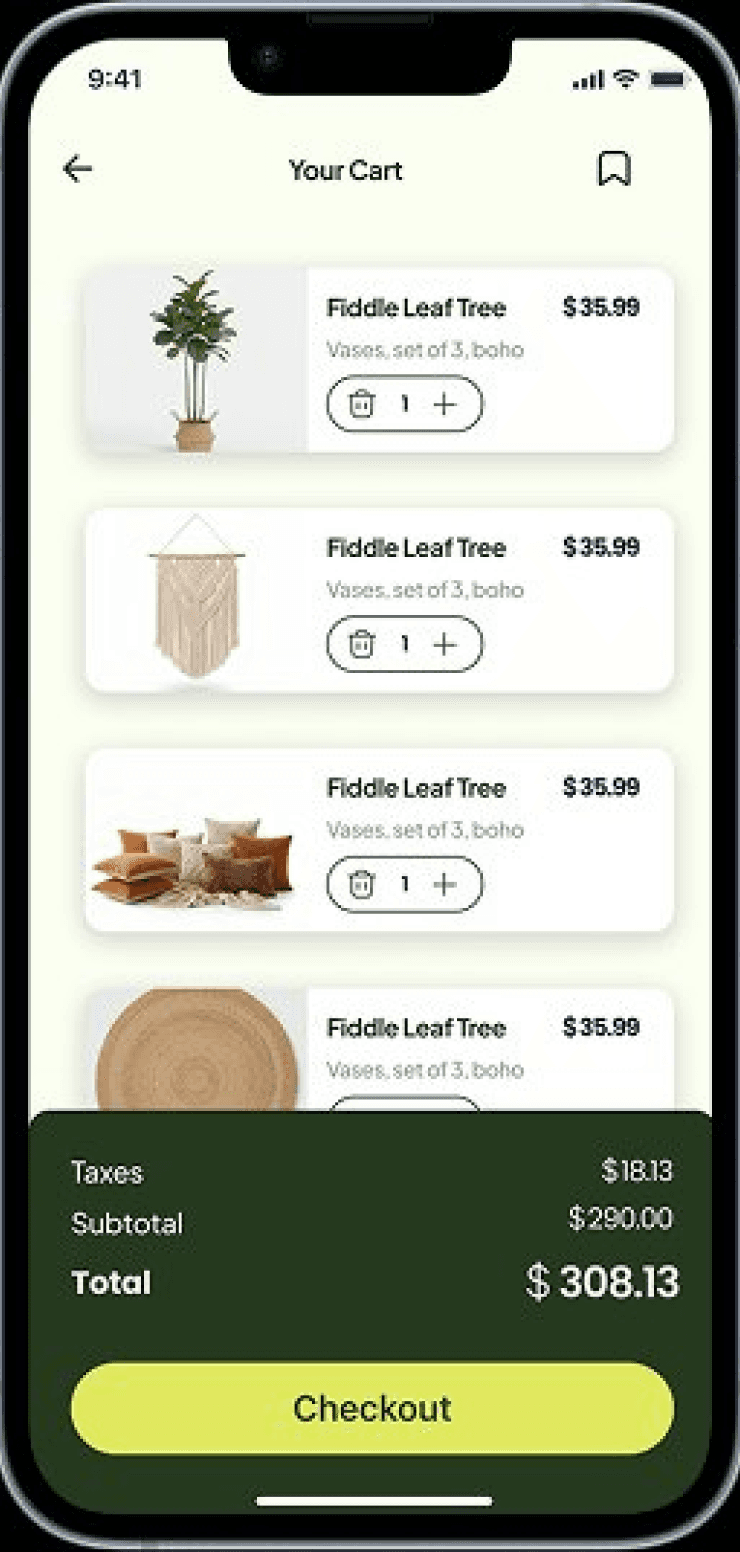
1 Tap to Buy the Room
When the room feels right, customer can buy entire collection in a single tap
Every item already fits teh budget ;you set from the start
The decision was made in the design, checkout is just the confirmation.
↑ Cart Completion & ↓ Cart Abandonment
Three
touchpoints.
One seamless
decision.
✓ Tested
1
tap
From inspiration to checkout in under 3 minutes
◎ Projected
↑
New market reach — solving for creative & budget barriers
◎ Projected
↑
Repeat engagement & brand loyalty beyond a single room
RESEARCH
If Users Know What They Want, Why Don’t They Buy?
Uncovering how a lack of confidence and clarity stalled motivated shoppers at critical moments.

Maria
“Which products should I get if I can only afford 3 or 4?”

Ron
“Spending time searching for the right things is tiring”

Lauren
“How do I get the look I want but within my budget?”

Ally
“I like this furniture but ...Will they look good in MY living room?”

Dean
I know the “look” I want...but don’t know what products to buy to pull it off”
60%
Had a clear vision but struggled with execution
100%
Abandoned purchases due to uncertainty outweighed confidence
80%
Cited budget as a primary constraint.
CONCLUSION
While intent was high, the "Certainty Gap" was fatal.
Users knew what they wanted and had the budget
but the interface failed to provide the reassurance needed to move from inspiration to investment.
USER JOURNEY
Mapping the
"Certainty Gap"
Users arrived inspired. They left overwhelmed. The journey map revealed exactly where confidence collapsed.
01
Starting
" I want my living room to feel less bare & more bright and cozy
—
Visits H2H with Pinterest Inspiration boards
02
Exploring
" How do I get the look I want within my budget?"
—
Searches for pieces that match her inspiration board
—
Adds Pinterest-inspired & spontaneous finds to her cart
03
Consideration
" Pieces don’t look like the one on Pinterest... "
" ...and will they match my Couch & Lamp? "
—
Second-guessing choices
—
Pieces feel different than what Pinterest shows
01
Quitting
" I want my living room to feel less bare & more bright and cozy
" I want my living room to feel less bare & more bright and cozy
—
Has a hard time translating vision into reality
—
Feels overwhelmed & loses motivation to continue
MARKET ANALYSIS
No One Had It All
The competitive landscape revealed a clear gap:
no single product combined the features users actually needed.
Features

Ikea Kreativ

Modsy

Home Design AI

Havenly
Effortless decor item discovery
✕
✓
✕
✓
Adheres to customer budget request
✕
✓
✕
✓
Fuses current decor with new items to create a cohesive design
✕
✓
✕
✓
Has a direct to consumer model (DTC)
✓
✕
✓
✕
Interior Design Autonomy (No Experts Required)
✓
✕
✓
✓
* Modsy is included in the analysis despite its closure because of how it successfully democratized what was once a luxury service for the wealthy and why its model resonated strongly with consumers.
Empower Users
Ikea, Kreativ, Home Design AI
✓
DTC model
✓
No expert needed
✕
No curation
✕
No budget awareness
vs
Guides Users Well
Modsy, havenly
✓
Budget -aware
✓
Cohesive curation
✕
Need an expert
✕
Not self-serve
DESIGN DECISION
Choosing the Flow that Closed
The Certainty Gap
Uncovering how a lack of confidence and clarity stalled motivated shoppers at critical moments. Uncovering how a lack of confidence and clarity stalled motivated shoppers at critical moments. motivated shoppers at critical moments.

→
✕ Not chosen
Style Quiz Approach
Answer questions about your style preferences, then browse a curated collection of matching products.
→
✓ Chosen
AI Approach
Upload a photo of your room or a design inspiration. AI generates room concepts that blend new pieces with your existing furniture, letting you preview products in context before purchasing.
Decision Criteria
Research Principle
✕ Style Quiz
✓ AI Concept
Delivers visual confidence
Users need to see an outcome before they can commit to a purchase
✕
Multiple prompts before any product is shown, friction before value
✓
Visual room concept delivered immediately, no setup required
Prevents decision paralysis
Does the format help users choose, or add to the overwhelm?
✕
List format results replicate the overwhelming scroll that caused drop-off
✓
Immersive, spatial interface mirrors how people naturally shop
Bridges inspiration to product
Users arrive with Pinterest boards or an image of their current setup/decor, the flow must honor that mental mode
✕
Small thumbnails don’t show how existing spaces can evolve into the user’s vision.
✓
Products shown styled in context: users see the outcome, not just the item
Supports design autonomy
User wants to feel in control, not funneled into a predefined style bucket
✕
Quiz categories impose a fixed style that can make customers feel trapped or dissatisffied
✓
Open Canvas, users explore freely, AI responds to their choices
USABILITY TESTING & ITERATION
Turning User Friction
Into Design Decisions
5 moderated sessions across 2 rounds.
1
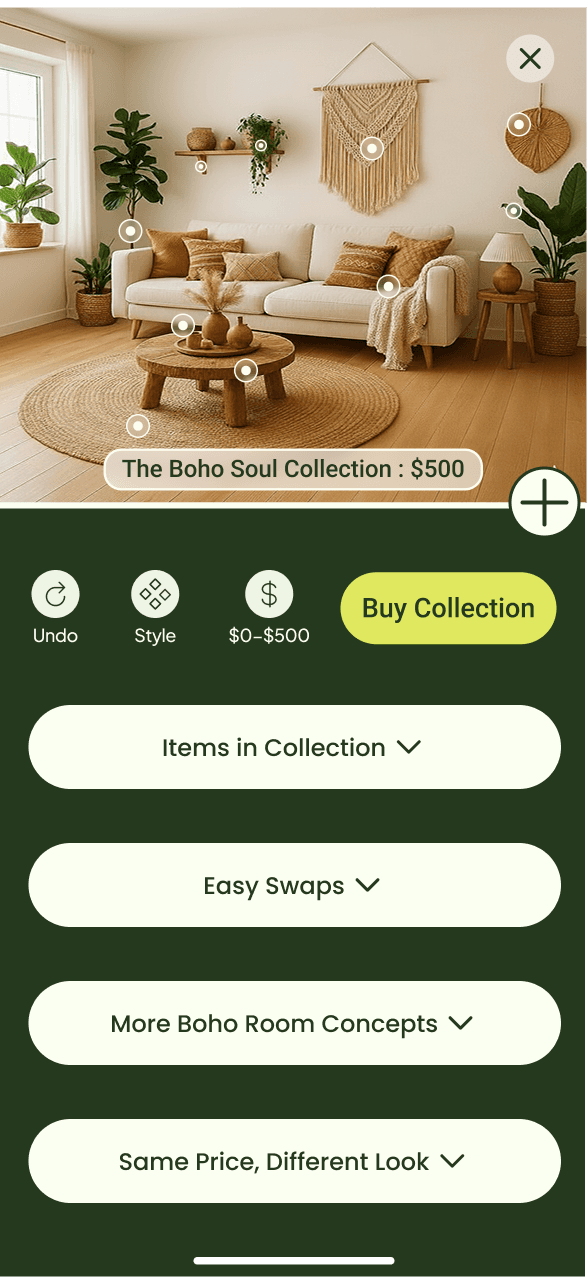
Reduce Cognitive Load at Entry
⚠ What i observed
4 of 5 users arrived confident but left doubting:
"Other Possibilities," competing CTAs, and tiny thumbnails pulled them into a browsing loop that stalled what should have been a clear decision.
before
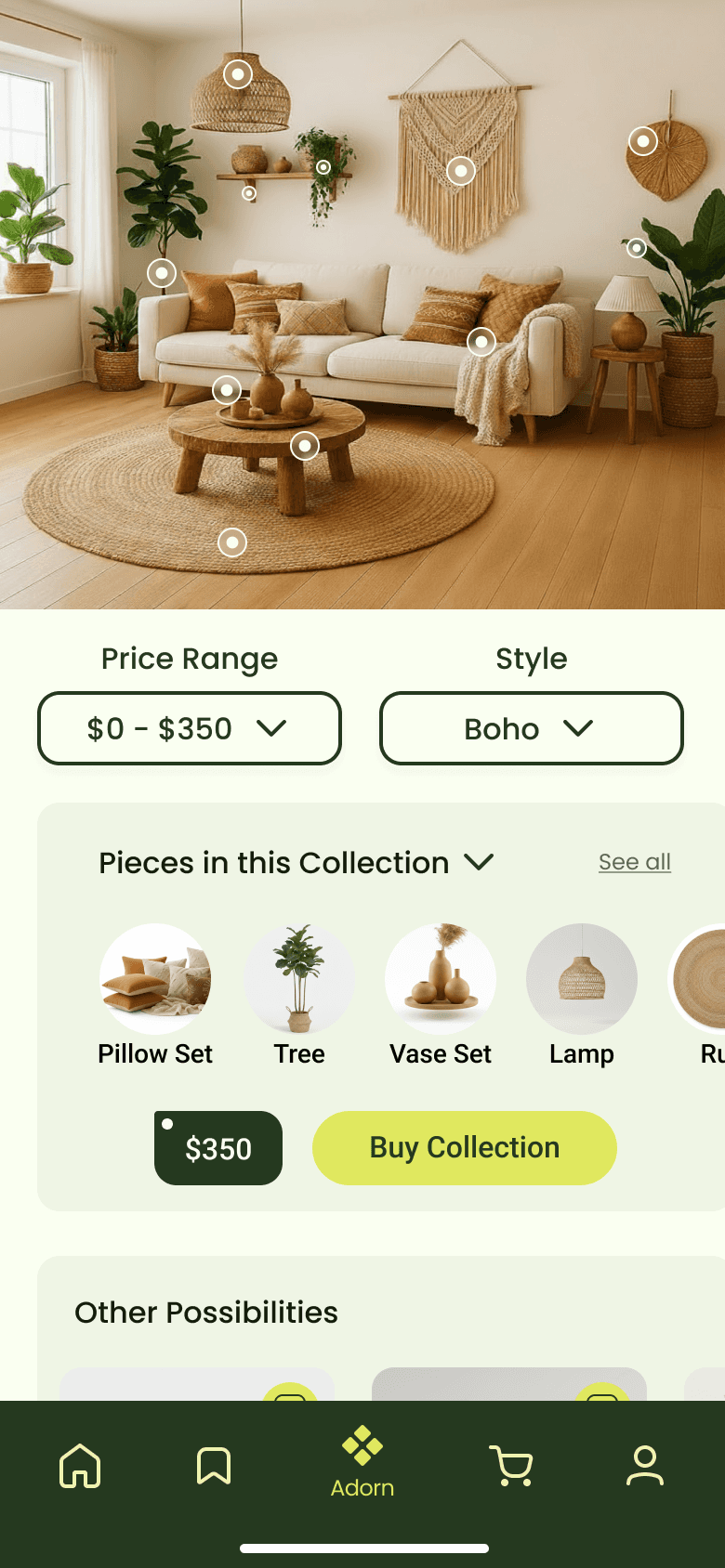

01
—
One primary CTA & streamlined
eliminates competing actions, giving users a clear and immediate next step.
↓ Hesitation
↑ Task Confidence
02
—
Expandable tabs replace visible clutter
Tabs surface detail only when needed. Reducing visual noise at entry without hiding useful content.
↓ Cognitive Load
↑ Decision Confidence
03
—
Nav Hidden on Entry for full immersion
Users engage with the experience before being reminded of everywhere else they could go
↓ Visual Focus
After

2
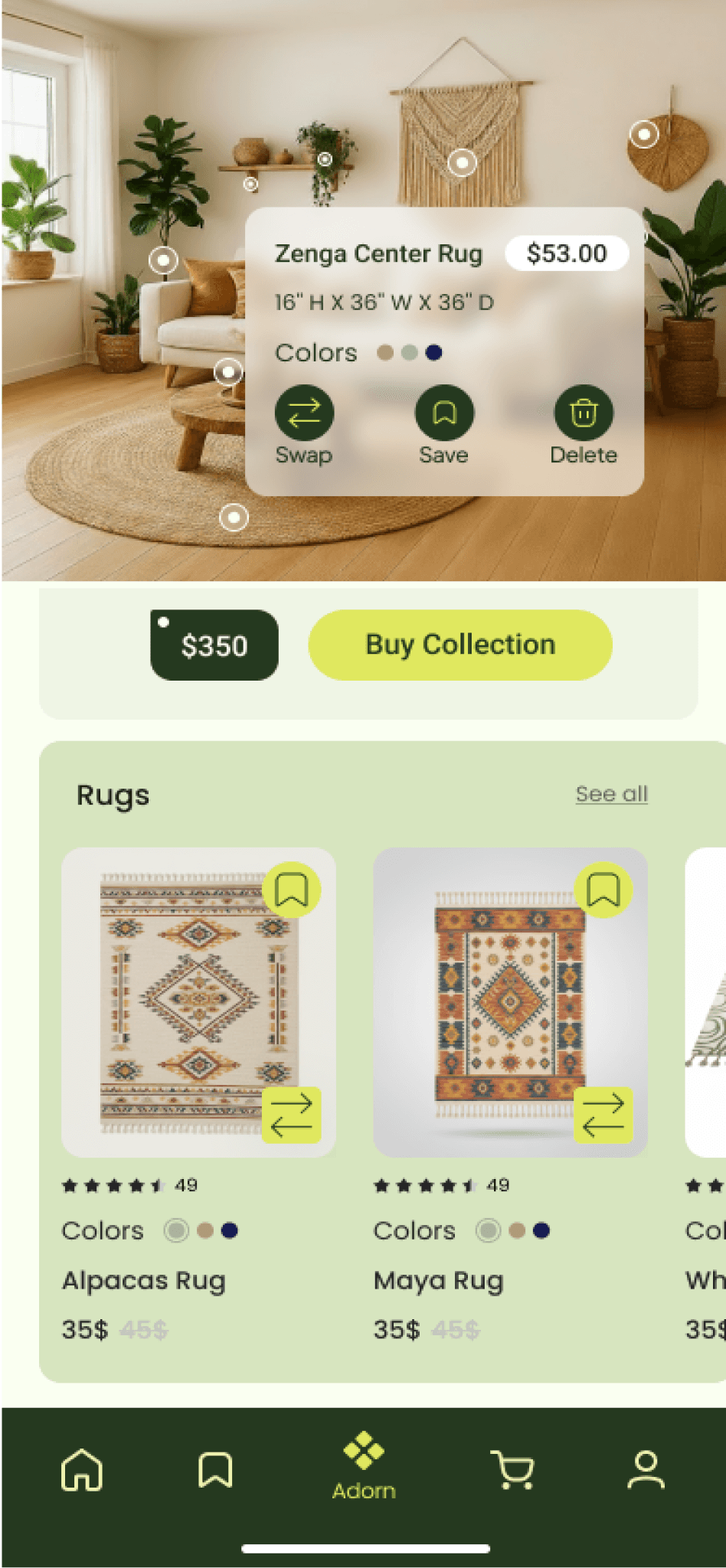
Make the System’s State Unmistakable
⚠ What i observed
5 of 5 users paused 5+ sec on entry
Unable to tell if they’d entered Swap mode or were still on the home screen, which indicated that the full browse view broke task continuity.
before

02
—
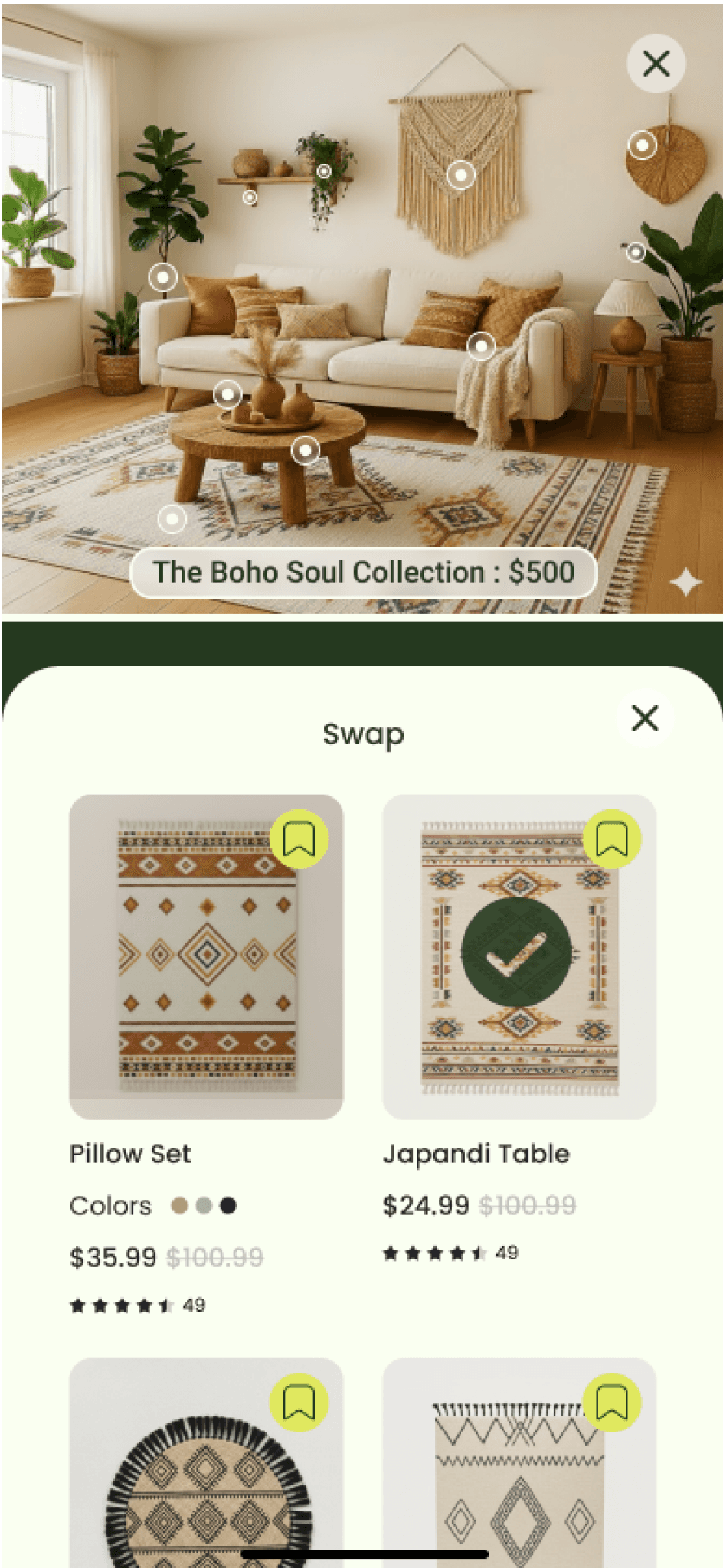
A dedicated swap modal + a vertical product list
Making options easier to scan & compare. A distinct "Swap" header and selection checkmark keep users oriented throughout.
↓ Decision Fatigue
↑ Product Exposure
After
3
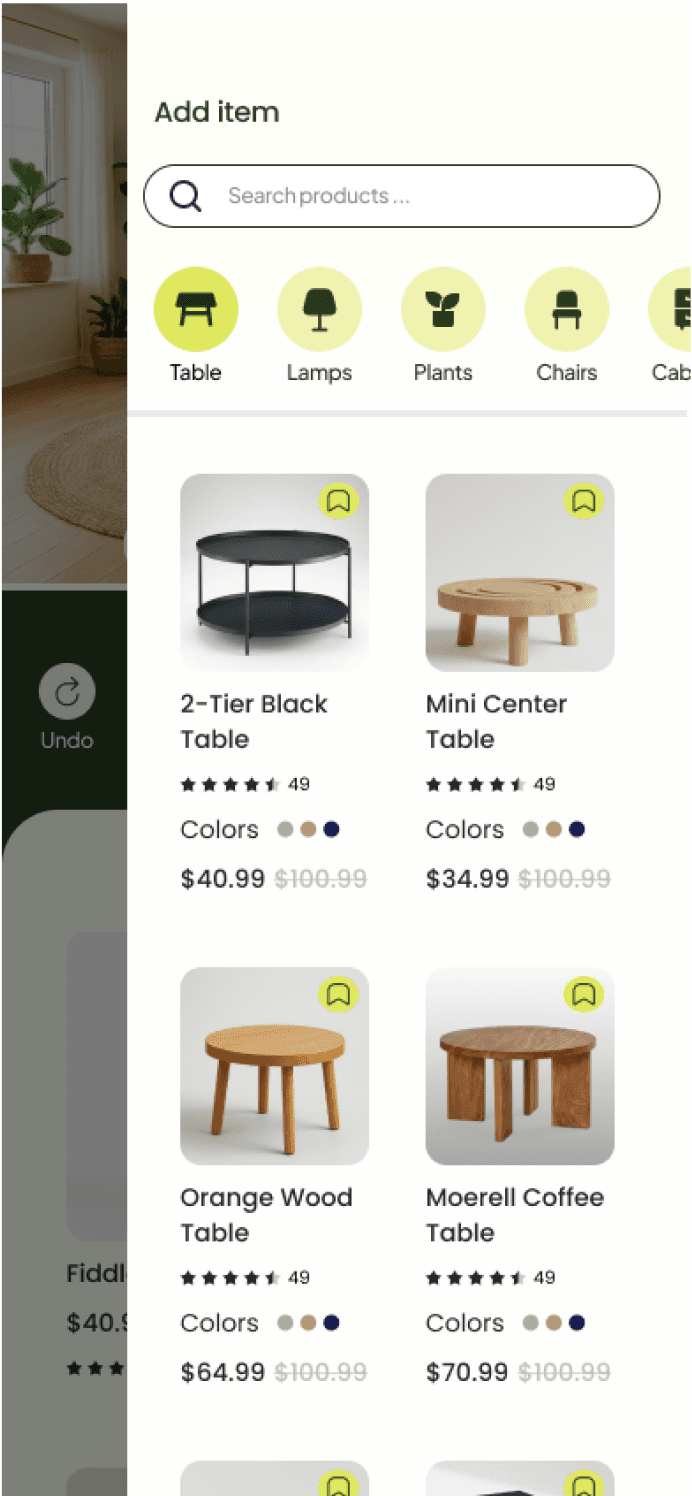
Turn Dead End Into Discovery
⚠ What i observed
3 of 5 users felt stuck when they couldn't add an item outside the original design
With no clear path forward, it became a critical drop-off point.
before
01
—
“+” button opens a searchable product browser
Turning a dead end into a discovery moment. Paired with Undo, users can explore freely knowing they can always return to their original design
↓ Drop-off Risk
↑ Product Discovery
After
FUTURE DIRECTIONS
Central Hub for Designed Rooms
An interface that appears before capturing a room photo — a persistent hub where all created and designed rooms live, so users can easily return to ongoing projects.
Information Architecture Enhancement
The "Add an Item" interface needs a more organized product hierarchy. When a user searches for lamps, subcategory navigation should surface to prevent dead-end browsing.
AI Design Assistant
A natural-language interface where users instruct the AI to modify a generated design — removing the need to manually hunt for products and making personalization effortless.
Lessons learned
Modular Feature Architecture
A new feature doesn't have to be constrained by the existing app shell. Users can be redirected into an entirely novel interface designed exclusively for that feature — similar to how webpage redirects work.
Mobile Navigation Design
Working with a fixed image occupying most of the screen deepened my knowledge of mobile menu patterns: drawer, FAB, Rudder, Sheet, and how well-designed menus make interactions feel natural.
AI-Driven Product Discovery
AI integration can exponentially increase product bundling, placing emphasis on overlooked items that would typically escape use attention, turning discovery into a business advantage.
Laura.
Let's connect
© 2026 Laura
Designed with intention, not just taste.