
UX INTERNSHIP · 2024
SOLORA
TECH.
The client wanted a visual refresh.
The data revealed a credibility crisis.
Role
UX Strategy, IA
& Design
Timeline
5 Week
Internship
deliverable
10 Pages &
Design System
solora.ca / waste-management
1A.RESEARCH: MARKET ANALYSIS
The client asked for a new look
The data told a a different story.
A deep competitive analysis across four market leaders revealed the same pattern: every competitor was leveraging trust signals: experience, compliance framing, ROI narratives, that Solora had completely overlooked. This wasn't a design problem. It was a credibility problem.
Market Landscape
Veolia
Cambi
Enerkem
Sagepoint
Solora
Experience & Track Record
✓
✓
✕
✕
✕
Technical solution education
✓
✓
✓
✓
✕
Risk & Compliance Framing
✓
✓
✕
✕
✕
Sustainability Impact
✓
✓
✓
✕
✕
Revenue & ROI Framing
✓
✕
✓
✕
✕
Implementation timeline Clarity
✓
✕
✕
✕
✕
Solora's score
0/6
The real gap: Trust not design
Solora had none of this. The site couldn’t establish credibility, educate its audiences, or convert qualified leads not only because the design wasn’t there but because the positioning strategy didn’t exist yet. A new look wouldn’t solve that.
The work had to shift from redesign to building trust.
02. INFORMATION ARCHITECTURE
Intent based Navigation Designed Around Trust
Rather than organizing pages by topic (the company's internal logic), I
grouped them by the job they do for the user — resulting in three
distinct clusters, each serving a different stage of the trust journey.
The organizing principle: three mental gates
The user research disclosed that each persona had the same recurring questions when deciding to hire on a company.
GATE 01
“What does this company actually do”
Service Pages
GATE 02
“But can I actually trust them?
Trust & Prcoess Pages
GATE 03
“Who are they & how do I reach them?
Conversion & Support Pages
sitemap - 3 purposeful clusters
The user research disclosed that each persona had the same recurring questions when deciding to hire on a company.
Home Page
“Service Pages”
What We Do
Service
Overview
Waste
Mgmt
Tech
Eval.
Env.
Analytics
Energy
Trans.
Business Goal
Self-qualify visitors before they reach a salesperson.
“Trust & Process”
Impact
Sections
Waste Mgmt Crisis
Cost of Inaction
UN Alignment
Trusted Partners
How We Work
Sections
Service Lifecycle
Impl. & Support
Solora Advantage
FAQ
Business Goal
Replace missing case studies — prove thinking, not
just results.
“Conversion & Support”
About
Sections
Company Story
Mission & Values
Project Partners
Sustainability Commitments
Contact
Sections
Contact Form
Location & Map
Business Goal
Serve audiences who evaluate people before they
evaluate products.
Page
Section within page
naming decisions matter
Even the nav labels were a strategic choice. "Solutions" vs "What We Do"
isn't cosmetic — it changes what users expect before they click.
REJECTED
✕
Services
Required users to interpret meaning, increasing cognitive load at exactly the wrong moment
Better suited for companies offering productized solutions rather than service-driven consulting
CHOSEN
✓
What We Do
Task oriented language reduces ambiguity and cognitive load
Would increase qualified lead conversion by setting accurate expectations before clicking
Why it matters: For a startup with no brand recognition, every nav label is an orientation tool. "What We Do" addresses the most common question when evaluating an
unfamiliar company.
Built to grow
The IA was designed as a scalable foundation — not a fixed structure. Phase 1 builds trust with limited proof. Future phases absorb richer content as Solora completes deployments.
MVP — Now
Establish Trust Without Data
→ Focuses on showing value without
project history
→ Process-as-proof: methodological
transparency closes the credibility gap
→ Minimal content footprint, maximum
trust architecture
Phase 2
Introduce Project Proof Points
→ Snapshot of top 3 projects using high level outcomes
→ Highlight 3 strategic wins e.g. 3 year deployment roadmap developed
→ Use “Coming Soon” placeholders for richer data
Phase 3
Full Data Backed Authority
→ Separate Impact & Projects into distinct pages
→ Use success data to showcase tangible, quantifiable advantages
→ Data-backed case studies, KPIs, audience based filters
1B.RESEARCH: UNDERSTANDING CLIENT NEEDS
Every persona had a different definition of “trustworthy”
I synthesized research into a framework that identified what users need to know, what builds trust, what creates friction, and how they frame the problem, thus helping create the entire experience.
Municipal & Infrastructure
Financial
& Public ROI
THE FRICTION
Needs immediate justification for spend, but startup data is still in progress.
UX SOLUTION
Process-as-Proof
Needs immediate justification for spend, but startup data is still in progress. Won't champion a vendor internally without answering: "What happens if this fails?"
Indigenous & Local Community
Cultural & Env.
Stewardship
THE FRICTION
Traditional tech platforms use jargon that feels alien to community values, triggers distrust immediately.
UX SOLUTION
Value-Centric Storytelling
Content framework that prioritizes narrative-driven modules over technical specifications.
Policy & Environmental Analysts
Regulatory
Compliance
THE FRICTION
Needs white papers to validate technology against legal standards. Credibility is earned through documentation and standards alignment, not design or testimonials.
UX SOLUTION
The Alignment Roadmap
Visual interface mapping current methodologies directly to national sustainability metrics and UN frameworks.
Tech. Vendors & Partners
Strategic
Growth
THE FRICTION
High financial risk if deployment is not guided by local expertise.
UX SOLUTION
Consultative UX Architecture
Positioned the platform as a Risk-Navigator, highlighting high-cost friction points in the vendor journey & showing how Solora removes each one.
⬡
AI
Leveraged
Research Methodology Note:
I replaced missing user access with AI-simulated persona interviews, modeling real decision scenarios to identify friction, trust drivers, and decision logic to create my personas. Click Here to See Peronsas.
1C:FROM ANALYSIS TO DESIGN CONSTRAINTS
Reposition the platform as a trust-building system, not a content repository
The research surfaced a critical question: could the platform be repositioned as a trust-building system without extending timeline? The answer was yes. Instead of a surface-level refresh, we reframed the challenge as a systems-level redesign, one where three key constraints drove the website design.
1
Serve Diverse Audiences
Municipal govt’s, enterprise partners,
investors, & Indigenous communities
each with competing trust needs,
simultaneously.
One site. Four audiences. No page trying to do everything at once.
2
Design for Scalability
Build an IA flexible to tell a credible story with limited proof today, while absorbing case studies, KPIs, impact metrics, as the company completes deployments.
The IA grows with the company, not against it.
3
Technical Authority & No Alienation
Establish credibility with investors &
municipal govt’s without adopting a corporate tone that alienates the grassroots and Indigenous audiences
Rigorous enough for analysts. Human enough for communities.
02:THE MAKEOVER
Page level decisions that brought
The strategy to life
Each page was designed to solve a specific trust gap from the reserach & competitive analysis. The decisions weren't aesthetic. They were strategic responses to what buyers actually need to say yes.
How We Work
Goal: BRIDGE ABSTRACT → CONCRETE
solora.ca / waste-management
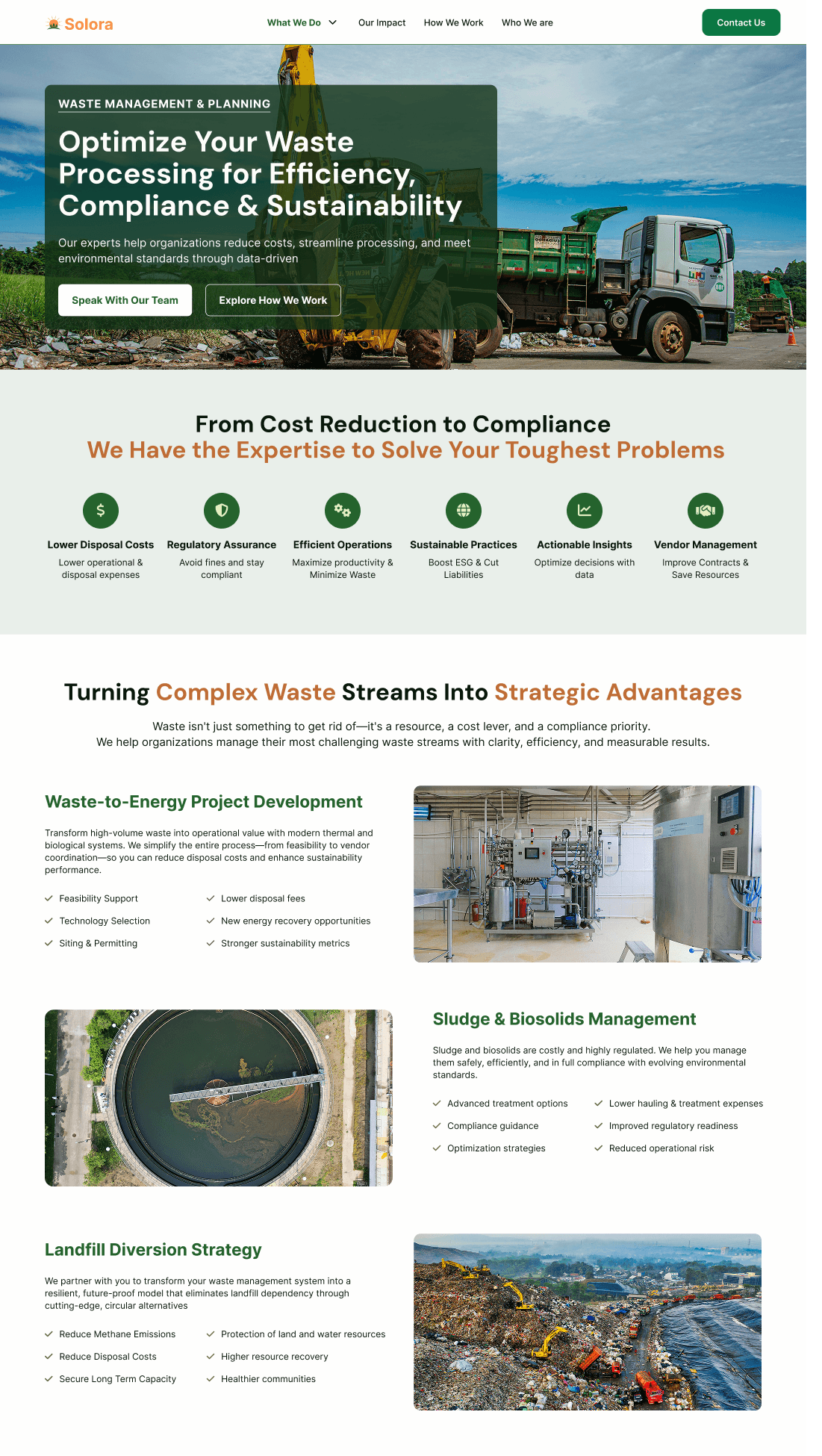
finding
Clients evaluate vendors on ROI and Risk reduction, not service breath. Pages listing what a service is with out connecting it to a measurable client outcome, fail at the moment of evaluation.
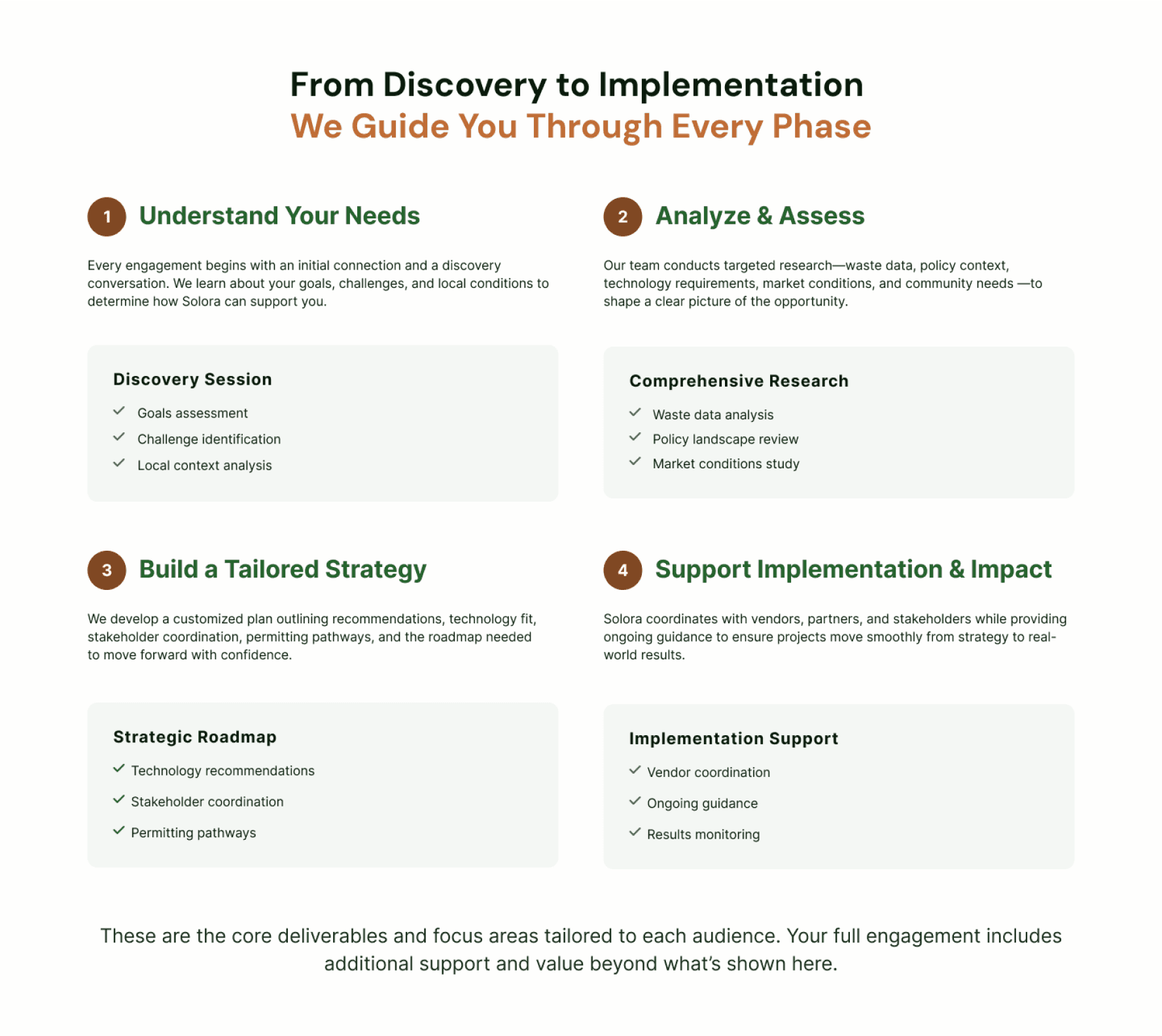
4-Phase Process Layout
Municipal buyers need to internally champion a vendor. Visualizing each phase lets them answer "what happens next?" reducing perceived risk before a meeting even happens.
↓ Hesitation
↑ Task Confidence
↑ Internal shareability
finding
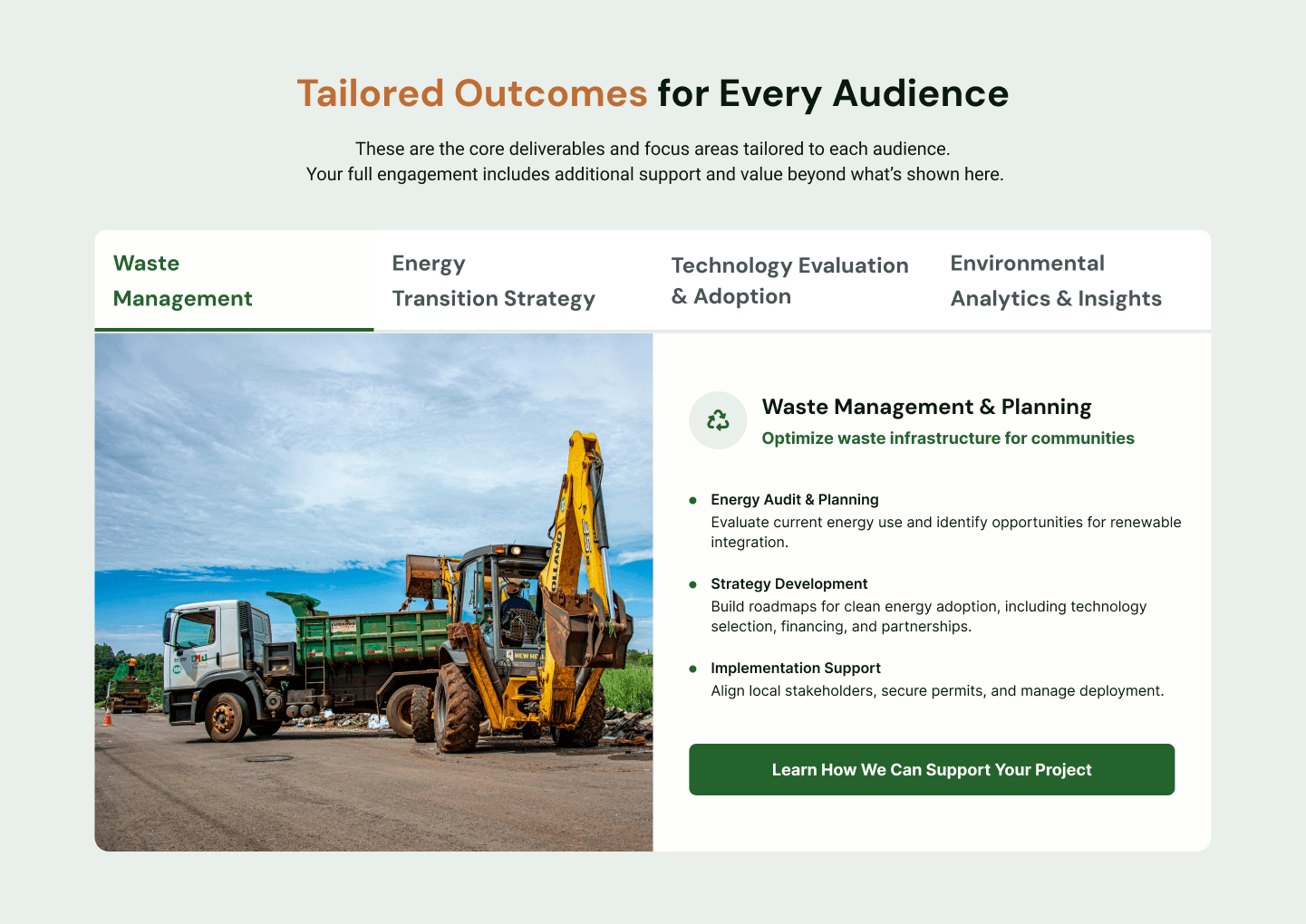
Customers who understand a company's process but can't visualize how it applies to their specific challenge are more likely to continue researching competitors.
Service Specific Outcomes
Each industry has unique success metrics. Showing a glimpse of tailored outcomes for each service in the how we work page intrigues customers and they have the CTA to click which will take them to the service specific page where they can find more out. lets prospects see exactly how your process applies to their situation, making the value concrete before they even reach out.
↓ Hesitation
↑ Task Confidence
↑ Internal shareability
solora.ca / waste-management
solora.ca / waste-management
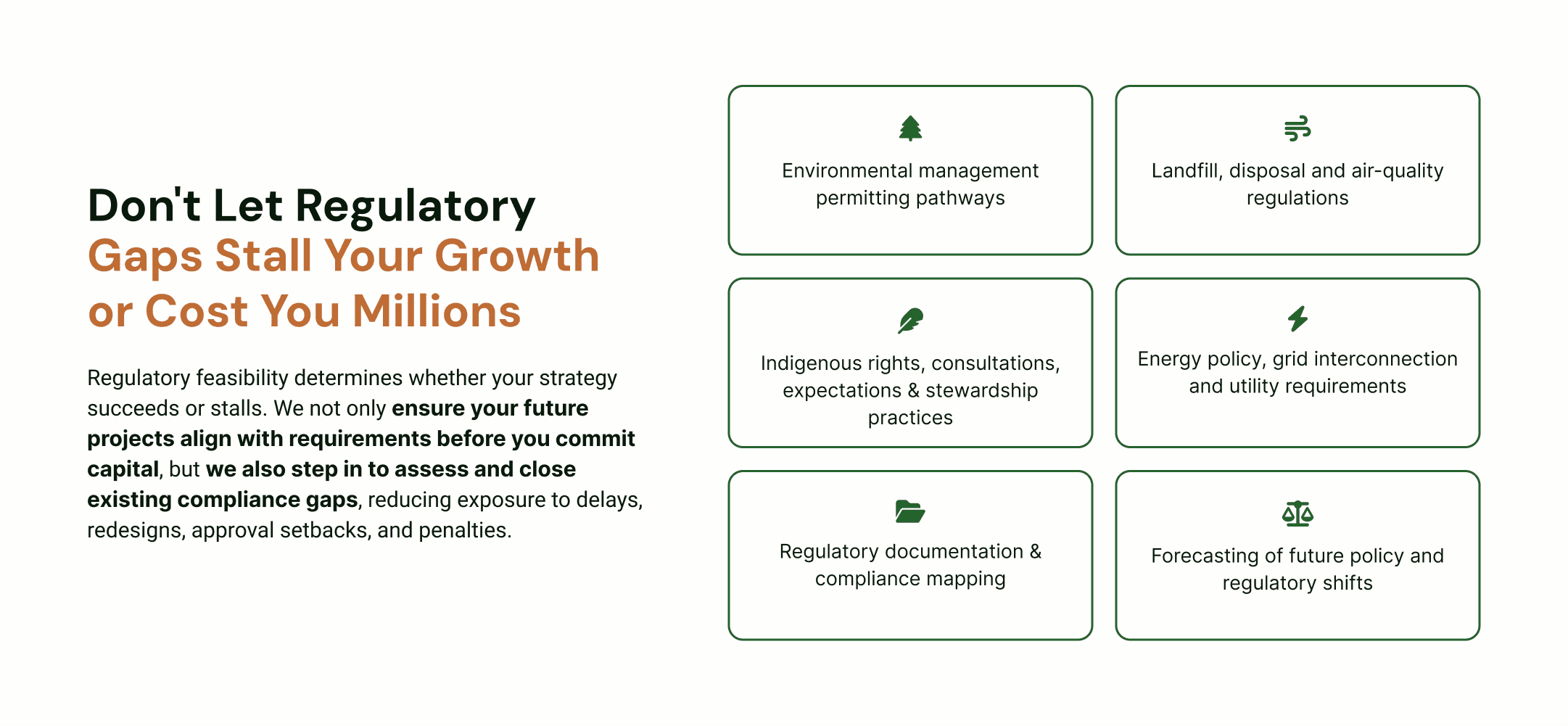
finding
Regulatory non-compliance is the #1 cause of project failure in this sector, but no competitor surfaced it proactively. Buyers didn't know to ask until a project was already at risk.
Regulatory Gap Section
Naming the risk before the buyer asks positions Solora as a strategic advisor, not a vendor. I added specific risk taxonomy (Indigenous
rights, grid interconnection) to signal genuine depth of expertise.
↓ Perceived Risk
↑ Trust Signal
↑ Expertise Credentials
Waste & Energy Transition
Goal: demonstrate capability
solora.ca / waste-management
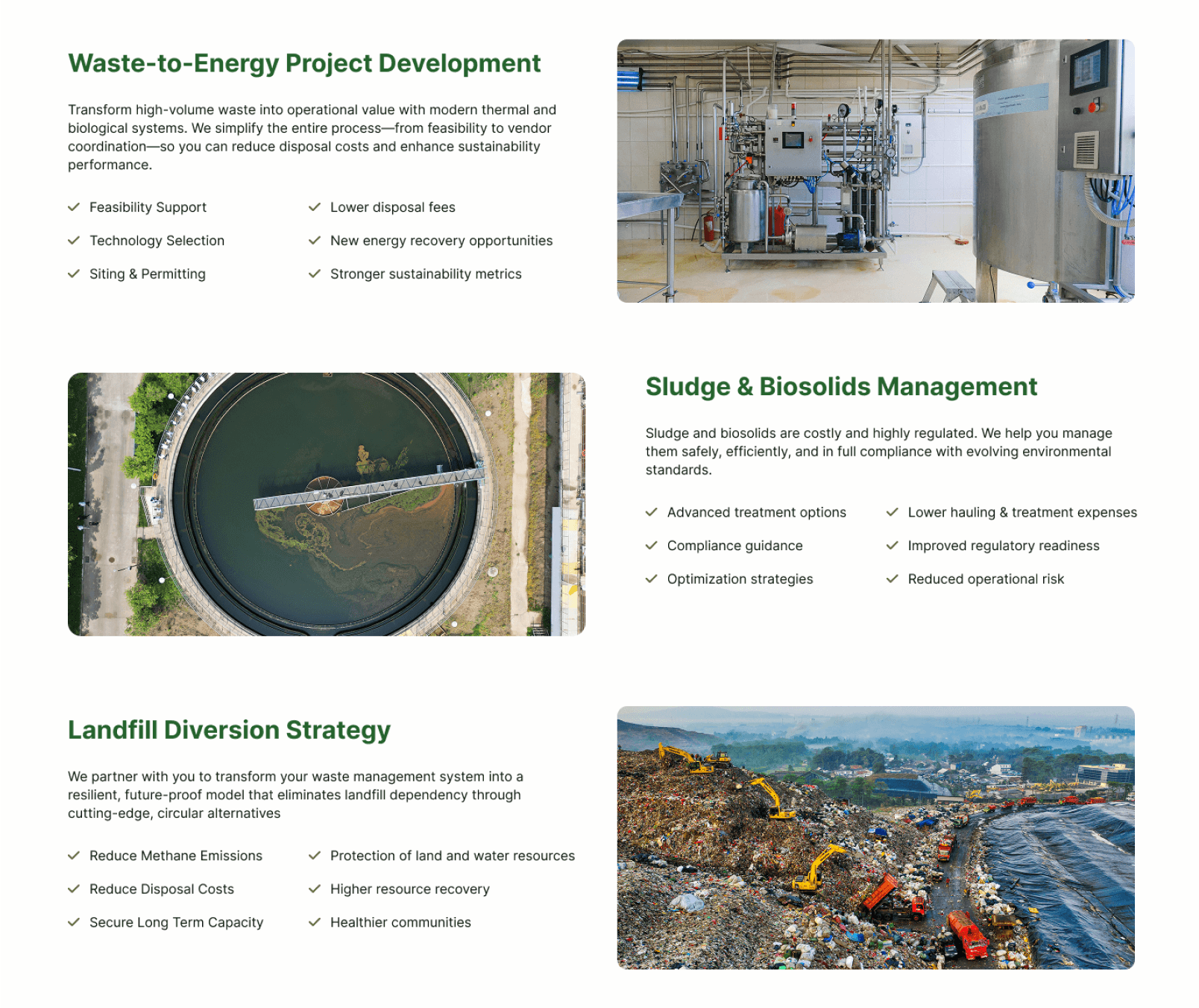
finding
Clients evaluate vendors on ROI & Risk reduction. Without completed projects, the company lacked proof—putting it at risk of failing at the moment of evaluation.
Benefit Framed Service Sections
Each sub-service lead with projected financial or environmental gains the client walks away with before explaining how it is delivered. This mirrors how buyers build internal approval documents, making the offer easier to champion up the chain.
↓ Decision Fatigue
↑ ROI Clarity
finding
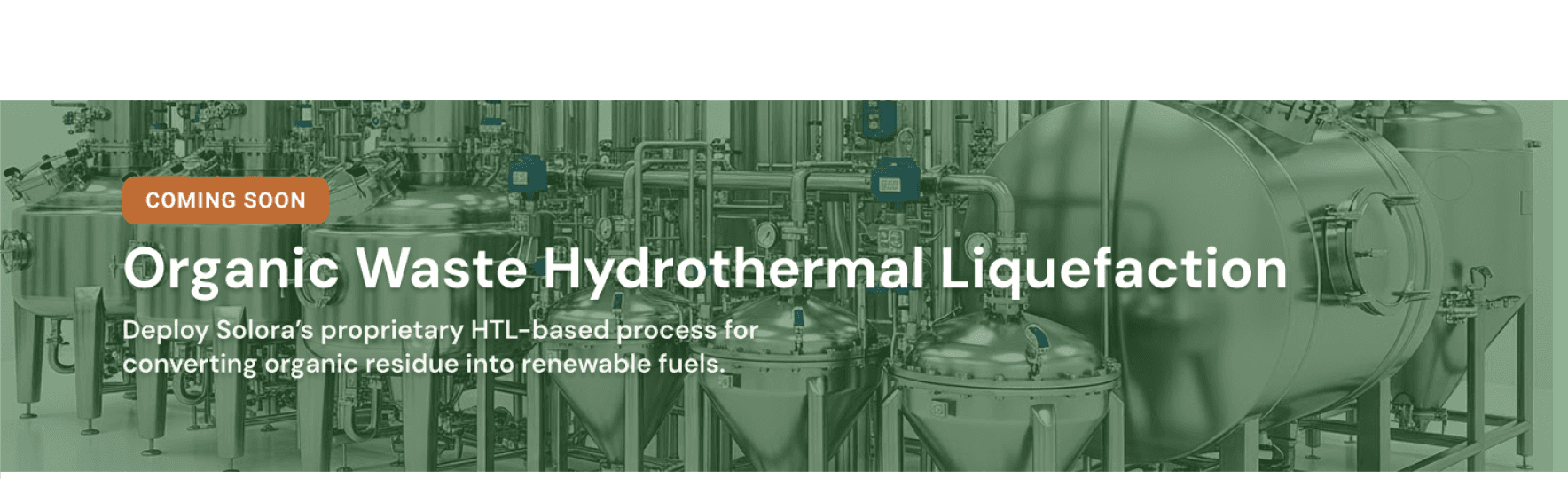
Solora has proprietary technology that customers would eventually be able to get from them. Thus I used this to signal ambition and capability.
Coming Soon Teaser
The Organic Waste Hydrothermal Liquefaction teaser signals that Solora is building proprietary technology — establishing technical ambition
without claiming completed work. "Coming Soon" framing is honest and forward-looking, which builds more trust than silence.
↑ Technical Credibility
↑ Forward Looking Signal
◎
After the project was delivered, I realized we could strengthen engagement by adding a CTA that invites users to enter their email and be the first to hear about updates
solora.ca / waste-management
Technology Evaluation & Adoption
Goal: speak to two buyers
solora.ca / waste-management
finding
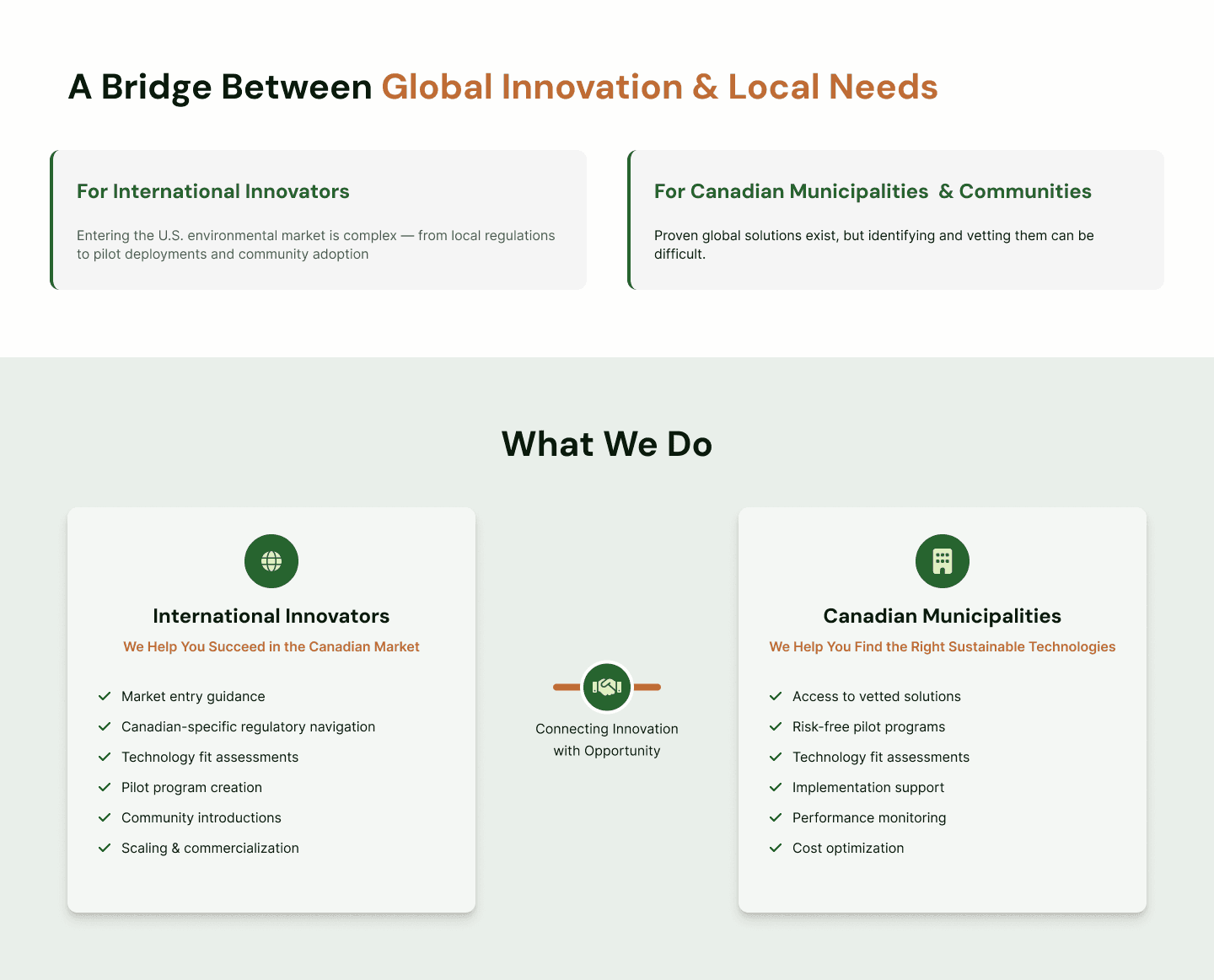
This service serves two completely different audiences:
Tech vendors wanting market entry and organizations wanting to adopt technology. A single page would alienate one group, a split page risked confusing both.
Dual Audience Framing
"A Bridge Between Global Innovation & Local Needs", one narrative thread holds two audiences: vendors need local knowledge, organizations need vendor-neutral guidance.
↓ Audience Confusion
↑ Position Clarity
finding
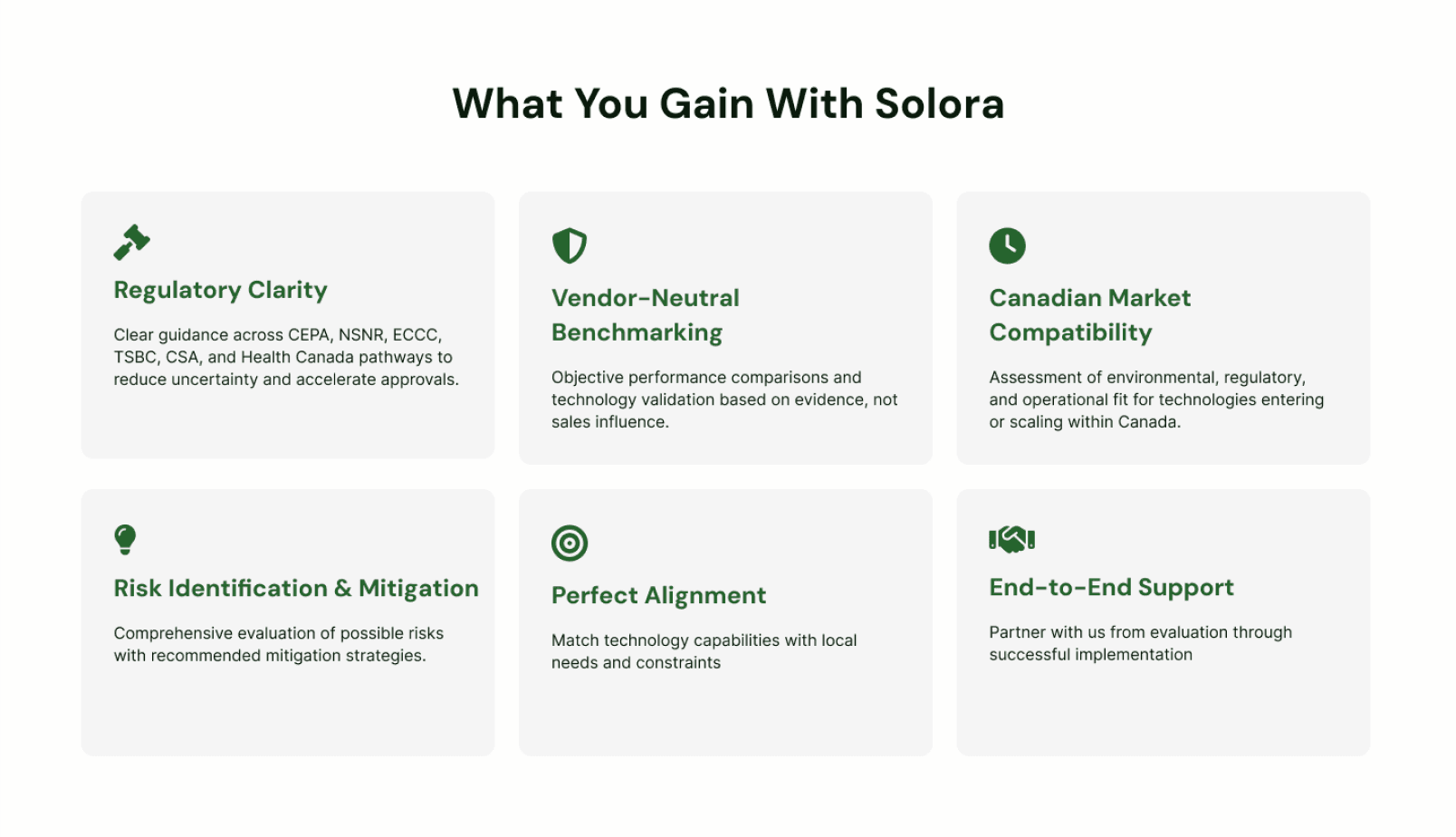
Without case studies or client logos, this page had no proof layer, making it the most trust-deficient page on the site. Buyers evaluating a complex, high-stakes service need tangible outcomes, not just capabilities.
Coming Soon Teaser
Naming specific gains anchors the page in tangible outcomes buyers can evaluate, matching the outcome-first pattern used across all service pages for consistency. It replaces the missing proof with specificity.
↑ Trust Deficit
↑ Outcome Specificity
solora.ca / waste-management
Technology Evaluation & Adoption
Goal: Community Trust
solora.ca / waste-management
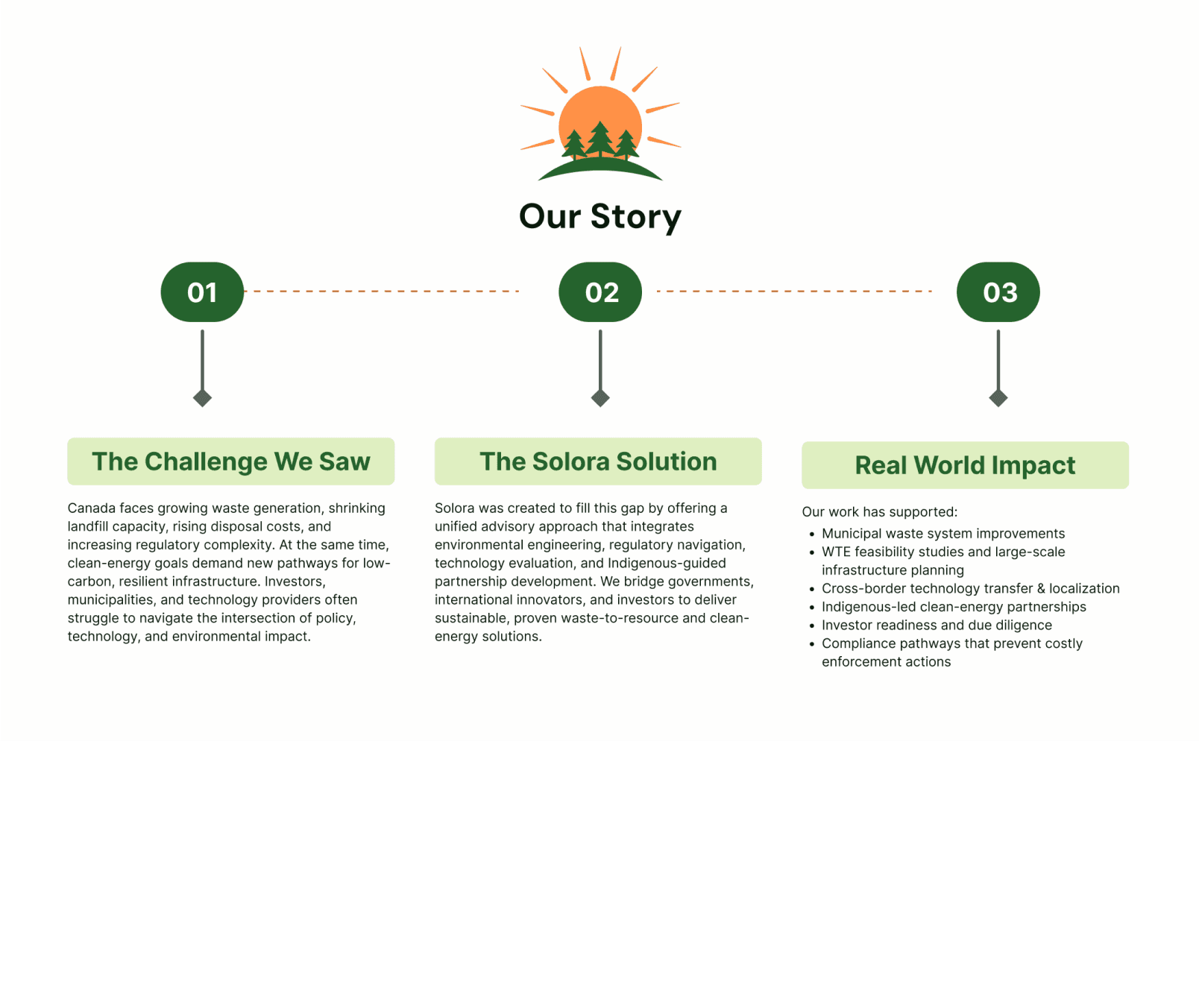
finding
Indigenous and community audiences trust people who come from a place of genuine care, not corporate messaging. On the About Page, they are evaluating alignment first: does Solora see the problems the way they dol, before caring about solutions.
Origin Narrative
Structuring the story as a problem-solving arc signals alignment with the audience's own concerns about waste, land, and energy before a single service is mentioned. It answers "do you get it?" before "can you help?"
↓ Corporate Distance
↑ Value Alignment
Laura.
Let's connect
© 2026 Laura
Designed with intention, not just taste.